
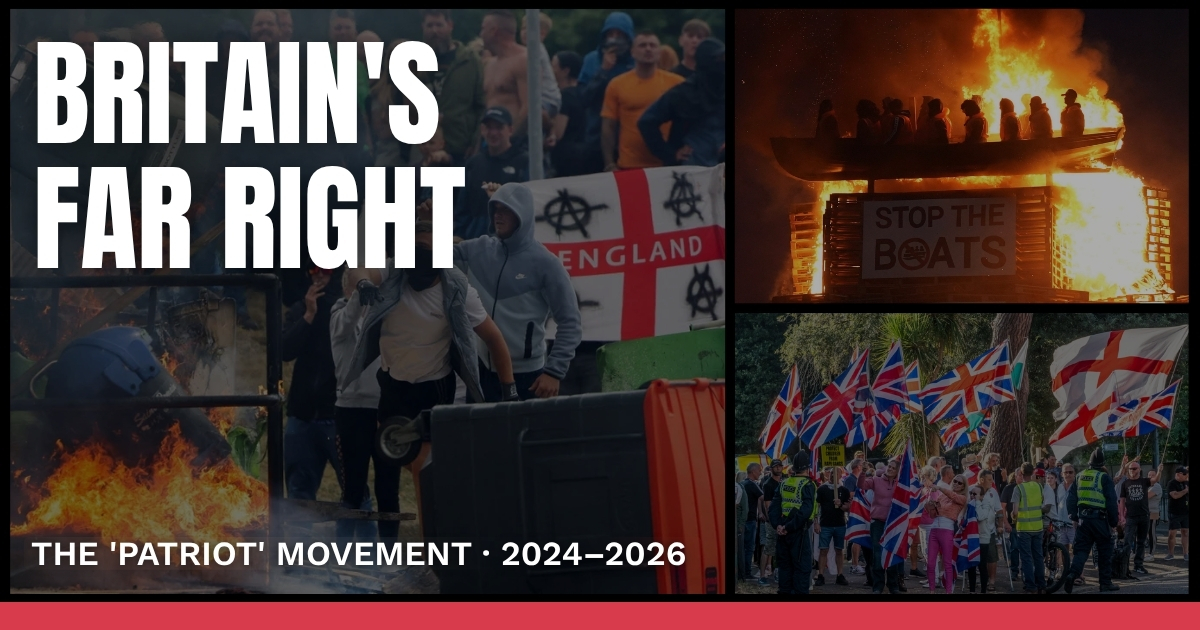
From the Southport riots of 2024 to masked men on the Kent coast in 2026: how Britain’s far right reorganised, who led it, and where Reform UK fits.
The summer of 2024 is the obvious place to start. On 29 July, three girls were murdered at a holiday dance class in Southport, and within hours a false name, a false religion and a false immigration story had been pinned on their killer. What followed was the worst disorder England had seen since 2011.
Two years on, Britain’s far right looks different. There are fewer marches behind a single banner and a great many more flags on lampposts. There are men in balaclavas on the Kent coast, livestreams from French beaches, and a populist party running county councils while keeping the street movement at arm’s length. Some of the faces are familiar. Several are new.
This timeline follows that journey: the riots, Tommy Robinson’s return, the asylum hotel protests of 2025, Operation Raise the Colours and the arrival of Patriot Platform in 2026. It also looks at where Reform UK fits, a question that needs more care than it usually gets.
One rule runs through the whole piece. Where a link between people or groups is documented, we say so and link to the source. Where it is alleged, disputed or simply inferred, we say that too. Several people named here are currently before the courts, and nothing in this article should be read as a finding of guilt.
Key dates at a glance
View the full timeline: July 2024 – October 2026
| Date | What happened |
| 29 July 2024 | Three girls murdered at a dance class in Southport |
| 30 July to 7 August 2024 | Riots spread across England and Northern Ireland |
| 17 October 2024 | Lucy Connolly jailed for 31 months over a post calling for asylum hotels to be burned |
| October 2024 | Tommy Robinson jailed for 18 months for contempt of court |
| 27 May 2025 | Robinson released early after his sentence is cut |
| July 2025 | Asylum hotel protests begin in Epping, Essex |
| August 2025 | Operation Raise the Colours flags appear on lampposts |
| 13 September 2025 | Unite the Kingdom march draws 110,000 to 150,000 to London |
| November to December 2025 | Raise the Colours members confront migrants in northern France |
| 14 January 2026 | France announces entry bans on ten British activists |
| 7 May 2026 | Reform UK gains around 1,450 councillors and 34 Senedd seats |
| 2 June 2026 | Violence in Southampton after protest over Henry Nowak case |
| 9 to 11 June 2026 | Racially motivated disorder in Belfast and elsewhere in Northern Ireland |
| June 2026 | Patriot Platform launched by Danny Thomas |
| 5 to 6 September 2026 | Masked Patriot Platform protests in Dover and Portsmouth |
| 22 to 29 September 2026 | Gosport protest; Thomas charged with criminal damage, denies it, and is refused bail |
| 4 October 2026 | Protest and 12 arrests in Gosport after 149 people rescued in the Channel are landed |
2024: Southport, misinformation and the riots
Bebe King was six. Elsie Dot Stancombe was seven. Alice da Silva Aguiar was nine. They were killed on the afternoon of 29 July 2024 at a dance class in Southport, Merseyside, and ten other people were injured.
The attacker was Axel Rudakubana, then aged 17, who was born in Cardiff to Rwandan parents. Police said early on that he was British born. That fact did not travel nearly as fast as the fiction. Within hours, posts on X and Telegram were circulating an invented Arabic name and claiming he was an asylum seeker who had arrived by small boat the year before. None of it was true, and by the time the correction landed it had already done its work.
The violence began the next evening and moved quickly from town to town.
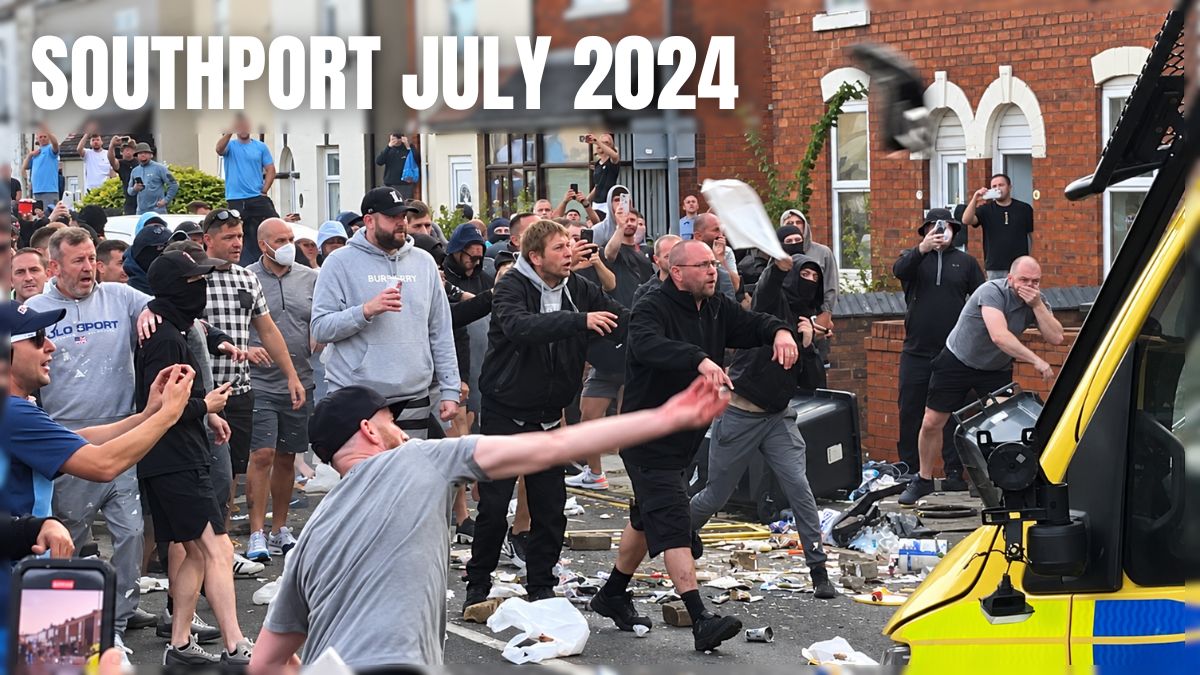
30 July, Southport. Hours after a peaceful vigil for the girls, a crowd attacked the mosque on St Luke’s Road. Bricks were thrown, a police van was set on fire and dozens of officers were injured.
31 July, Hartlepool, Aldershot and London. In Hartlepool a community centre was targeted, and in Aldershot disorder broke out outside a hotel housing asylum seekers. In Westminster, an “Enough is Enough” demonstration outside Downing Street turned violent and police arrested 111 people, Al Jazeera reported. One of the men photographed at that demonstration, Danny Thomas, returns later in this story.
2 August, Sunderland. After a quiet night nationally, several hundred people rampaged through the city centre, attacking police and setting fire to a car and to a building next to a police office, Al Jazeera reported. Northumbria Police said its officers had faced “serious and sustained levels of violence, which is utterly deplorable” (Northumbria Police; PA).
3 August, Liverpool, Hull and beyond. The worst single day, with disorder in Hull, Liverpool, Blackpool, Stoke and elsewhere, according to the Home Affairs Committee. In Walton, Liverpool, a crowd of around 300 set fire to the Spellow Lane library hub, which had reopened the year before after a community makeover. Merseyside Police said rioters tried to stop firefighters reaching the blaze and threw a missile at a fire engine (LBC). In Hull, protesters made an unplanned move to a hotel housing asylum seekers, the committee found.
4 August, Rotherham, Tamworth and Middlesbrough. Rioters attacked two hotels housing asylum seekers, at Manvers near Rotherham and in Tamworth. South Yorkshire’s chief constable told MPs that the people inside the Rotherham hotel had been at risk, and in Tamworth rioters tried to set fire to a hotel housing 135 asylum seekers while officers had petrol poured on them, the Home Affairs Committee reported. There was also serious disorder in Middlesbrough that day.
The riots largely ended on 7 August. A list of immigration advice centres said to be targets had circulated online. Thousands of antiracist counterprotesters turned up at those addresses instead, and the expected violence mostly failed to materialise.
The scale is easy to forget. Police recorded 246 separate protests, counterprotests and incidents of disorder, 88 of them classed as significant, and by 22 January 2025 had made 1,804 arrests and brought 1,072 charges, most for serious public order offences, according to the Home Affairs Committee’s report. At least 302 officers were injured.
Two narratives did most of the heavy lifting. The first was that the killer was a migrant, which was false. The second was “two tier policing”, the claim that rioters were being treated more harshly than other protesters had been. Tommy Robinson was among those pushing it on X while the disorder was under way. The Home Affairs Committee examined the claim and said it had seen no evidence to support it. It called the claims baseless and found the police response entirely appropriate given the violence on display (committee report). The claim has not gone away, and it resurfaced almost word for word in 2026.
Tommy Robinson, the founder of the English Defence League, was abroad for most of the unrest but posted about it constantly to a very large online audience. No court has found that he organised any of the riots. What the episode showed was how little formal organisation was needed. A rumour, a few high reach accounts and a list of venues was enough.
None of this came from nowhere. The policing inspectorate later found that a run of incidents across 2023 and 2024 should have warned police that serious disorder was coming, including a protest in Rotherham over footage of an arrest at Manchester Airport only days before Southport. The far right had been rebuilding for some time. Southport gave it a trigger and a crowd.
Flags were part of the picture from the start. England flags and Union flags were carried at riot after riot, and in Rotherham a mosque was later vandalised with a St George’s flag, Stand Up to Racism told the Guardian. But in 2024 the flag was something rioters carried. There was no organised campaign to tie it to lampposts or paint it on roundabouts. That came a year later.
The courts moved unusually fast, and online posts were prosecuted alongside physical violence. On 17 October 2024, Lucy Connolly, whose husband was then a Conservative councillor in West Northamptonshire, was jailed for 31 months at Birmingham Crown Court after pleading guilty to publishing material intended to stir up racial hatred. On the day of the murders she had posted on X calling for mass deportation and for hotels housing asylum seekers to be set on fire, a post viewed 310,000 times before she deleted it, LBC reported. On 20 May 2025 the Court of Appeal refused her leave to appeal against the sentence (Connolly v The King [2025] EWCA Crim 657). Kemi Badenoch and Rupert Lowe both took up her case, and she became a fixture of the free speech arguments heard at Robinson’s marches.
Rudakubana pleaded guilty in January 2025 and was jailed for life with a minimum term of 52 years, the Crown Prosecution Service said. His school had referred him to Prevent three times between 2019 and 2021, and each time his case was closed before reaching the Channel programme. The government’s interim Prevent commissioner later concluded that the attack was not motivated by any clear ideology, following a review of the case. For the people who had rioted in the girls’ names, that made very little difference.
Tommy Robinson and the rebuilding of a movement
Robinson founded the English Defence League in Luton in 2009 and left it in 2013. The EDL faded long ago. Robinson did not. By 2024 he was less the leader of an organisation than a broadcaster with a following, able to fill a square in London without anything resembling a membership list.
In October 2024 he was jailed for 18 months for contempt of court, having admitted repeatedly breaching a High Court order not to repeat libellous claims about a Syrian refugee. Prison raised his profile rather than lowering it. In January 2025 Elon Musk began campaigning for his release. When Nigel Farage said Robinson was “not right for Reform”, Musk posted on 5 January that “The Reform Party needs a new leader. Farage doesn’t have what it takes”, Reuters reported. Robinson walked out of HMP Woodhill on 27 May 2025, two months early, after the High Court cut his sentence by four months. The judge noted an absence of remorse but accepted he had shown a change in attitude, Al Jazeera reported. Outside the prison he thanked Musk and promised his supporters a free speech festival.
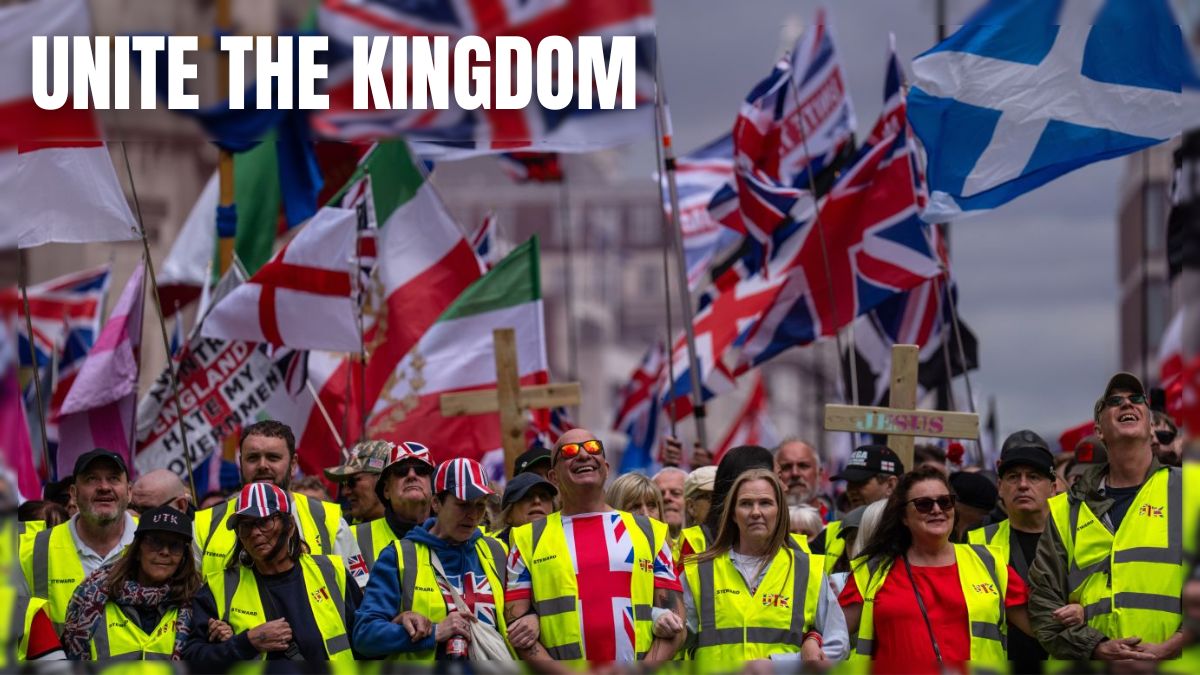
He delivered it on 13 September 2025. His Unite the Kingdom march drew between 110,000 and 150,000 people to central London on the Metropolitan Police’s estimate at the time, against roughly 5,000 at a Stand Up to Racism counterprotest, PA reported. Musk addressed the crowd by video link. Most marchers were peaceful. A minority were not, and much of the violence came as people tried to break through police lines towards the counterprotest. Initial figures put the number of injured officers at 26. The Met later disclosed that 37 officers were injured and a further 11 were assaulted without injury, in a Freedom of Information release.
Two things about that day matter for what came later. The first is tone. The event leaned heavily on Christian imagery, with worship music on stage, a theme the newer groups would take much further. The second is absence. Farage stayed well away, and Reform has kept Robinson at arm’s length ever since. The hostility runs both ways. Robinson has attacked Farage in crude terms and objected to Zia Yusuf, who is Muslim, holding a senior Reform role, Matthew d’Ancona has noted.
Robinson’s party links lie elsewhere. In August 2025 he announced in a video that he was joining Advance UK, the party Ben Habib founded after leaving Reform, and urged his followers to do the same. Habib has since said Robinson is welcome in the party (UnHerd; Searchlight).
By 2026 the crowds were thinning. Police estimated that around 50,000 people would join a second London march on 16 May 2026, less than half their estimate for September 2025 (LBC), and Hope not Hate said turnout fell short of what organisers had promised. But Robinson’s pull as a convenor held. On 2 June 2026 he attended a protest of around 1,000 people outside Southampton’s central police station, after the release of bodycam footage showing how police had handcuffed Henry Nowak, an 18 year old student, as he lay dying from stab wounds in December 2025. Part of the crowd later moved to Portswood, where violence broke out. Sentencing several men at Southampton Crown Court, Judge William Mousley KC called it a hate crime driven by hatred of the police and, in some part, by racist views, PA reported. There is no suggestion Robinson took part in that violence.
That is the pattern worth holding on to. Robinson rarely runs the groups that make the news. He amplifies them, appears at their events and gives them an audience. Organised groups and loose online networks both orbit him, which is exactly why he is so hard to pin down.
From street protests to the politics of 2025
If 2024 was about a rumour, 2025 was about a building. The asylum hotel became the movement’s most reliable organising tool, because it is local, visible and permanent in a way a news story is not.
The template was set in Epping, Essex, in July 2025. Protests began outside the Bell Hotel after an asylum seeker staying there was charged with sexually assaulting a 14 year old girl, LBC reported. Some demonstrations turned violent, and men trying to tear down the hotel’s sign were filmed chanting Robinson’s name, UnHerd reported. Within weeks, copycat protests had appeared outside hotels across England. Some were run by residents with no previous political involvement. Others drew familiar activists.
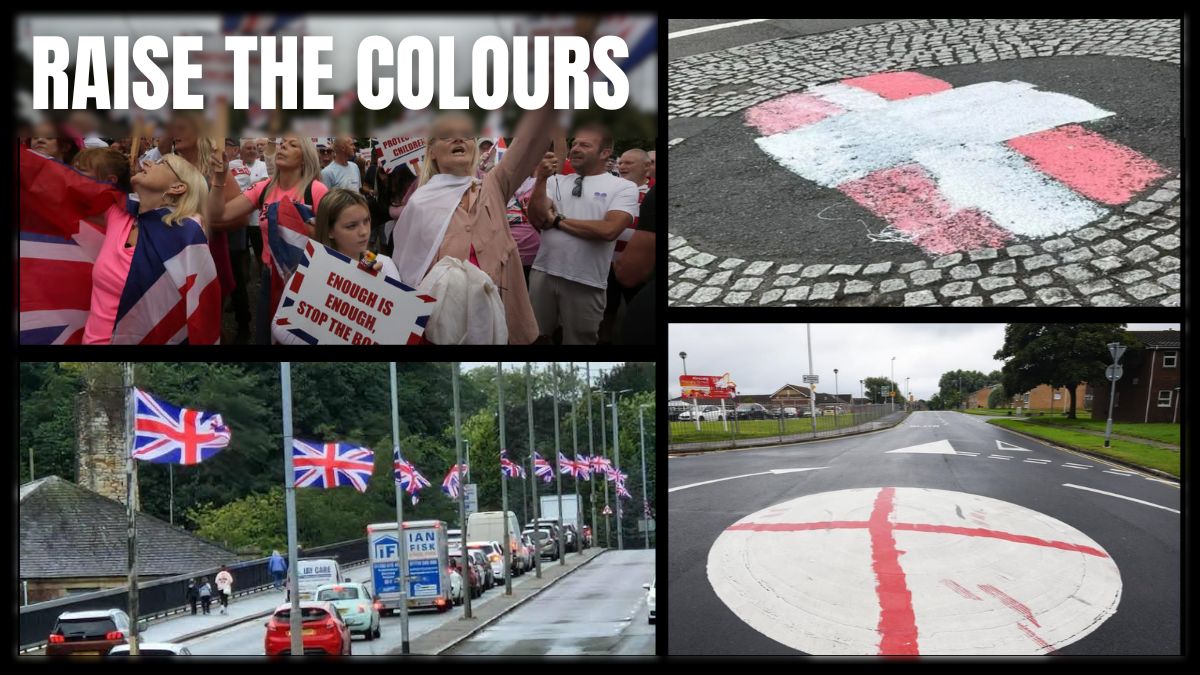
Then came the flags. In August 2025, St George’s Crosses and Union flags began appearing on lampposts and painted on roundabouts, first around Birmingham and then across England, Scotland and Wales, under the banner of Operation Raise the Colours. It arrived weeks after the same flags had flown for England’s women at Euro 2025, which lent it a ready made innocence.
Who started it has several answers, all self declared. A Birmingham group called the Weoley Warriors claims it. So does the Raise the Colours group covered below. So does Andy Currien, a former bodyguard to Robinson who was running security for Britain First in 2025, according to the Birmingham Dispatch and Hope not Hate. Britain First’s leader, Paul Golding, said publicly that the party had donated 75% of its flag stock to the campaign, AFP reported. Supporters insist it is simply patriotism. Many residents saw it differently. A YouGov study in October 2025 found that 55% of ethnic minority adults and 49% of white adults thought people putting up St George’s crosses were mostly expressing hostility to migrants or ethnic minorities rather than national pride.
Mainstream political responses focused largely on whether the flags represented patriotism or division. Kemi Badenoch called it “shameful” for councils to take the flags down. Keir Starmer said he was “very encouraging of flags”, while warning that they could be devalued when flown purely for divisive purposes. Reform councillors defended them, and Reform run Nottinghamshire County Council spent £75,000 putting up 164 Union flag banners of its own.
What changed in 2025 was the shape of activism. The older far right ran on formal organisations with names, officers and newspapers: the National Front, the BNP, the EDL, Britain First. The newer version runs on local crews, WhatsApp groups and livestreams, raising money through crowdfunding and recruiting through short videos. The historian Nigel Copsey describes local flagging crews that “drew sustenance from the far right” without being formally part of it. The sociologists Rohanna Bell and Tahir Abbas describe a shift from spectacular protest to “the durable production of everyday environment”. A march lasts an afternoon. A flag outside your house stays up until somebody takes it down, and taking it down became its own flashpoint, with council workers in York, Hertfordshire and elsewhere reporting threats and abuse.
Reform UK and the changing political landscape
Any honest account of this period has to deal with Reform UK, and has to do it carefully. Reform is not a street movement, it does not organise the protests described in this article, and it rejects the far right label. Some journalists and campaign groups apply that label anyway; others call the party populist or radical right. The evidence is set out below.
The electoral story is simple enough. Reform won five seats at the July 2024 general election. In the local elections of May 2025 it took 677 seats and control of several councils, including Kent and Staffordshire. It has led opinion polls in England ever since, as researchers at Aberystwyth University noted. On 7 May 2026 it gained 1,451 councillors and control of 14 more councils, according to BBC figures compiled by the NFU, and won 34 seats in the Senedd to become the main opposition in Wales. By late summer 2026 its poll lead had begun to slip amid a run of stories about party finances, Al Jazeera reported.
On rhetoric and policy, the overlap with the street movement is real. Reform has campaigned hardest on small boats, asylum hotels and grooming gangs, the same issues behind most of the protests in this timeline. Farage has said a Reform government would deport 600,000 people. Its councils have defended unauthorised flags, and when Oxfordshire County Council won an injunction against lamppost flagging in June 2026, Reform MP Richard Tice accused the council’s Liberal Democrats of hating patriotism.
On people and organisations, the picture is more mixed, and it is worth being precise about it. Farage has refused to let Robinson join Reform and stayed away from Unite the Kingdom. Raise the Colours is a different case. At Reform’s conference in Birmingham on 5 September 2026, Ryan Bridge, then on police bail, was one of the audience members invited to put questions to Farage. He asked Reform to take up his plan for raising flags in Reform run council areas. Farage replied: “I’ll give it to our lawyers. If we can help you legally with this fight, we will help you,” LBC reported. Bridge told the Guardian he had been invited to the conference. The following day, Thames Valley Police announced that he had been charged with 14 offences. None of this amounts to membership or funding, and we found no reported link of any kind between Reform and Patriot Platform. But it is public encouragement of a campaign, which is a very different posture from the distance Reform keeps from Robinson.
What has been shown is a party that cannot quite agree how to talk about the activists. After masked Patriot Platform members blocked roads in Dover in September 2026, Farage told ITV News he did not approve of “masked people turning up and protesting”, and later called for balaclavas to be banned in public. The Guardian reported that the party was divided internally over its response. In Portsmouth, Patriot Platform’s founder confronted Reform’s home affairs spokesperson Zia Yusuf on camera over Farage having reportedly dismissed Unite the Kingdom marchers as knuckle draggers, The Independent reported. Yusuf replied that there was never any excuse for violence against police officers.
The pressure on Reform now comes from its right as well as its left. Restore Britain, led by the former Reform MP Rupert Lowe, declared itself a party in February 2026 and has set out to challenge Reform from the right on immigration. Hope not Hate has published research on the activists gathering around Restore Britain. Whether that pushes Reform towards the street movement, or gives it something to define itself against, is one of the open questions of the coming year.
Raise the Colours: from lampposts in 2025 to vigilantism in 2026
Operation Raise the Colours is the loose national campaign. Raise the Colours is something narrower: a group founded by two Birmingham area businessmen, Ryan Bridge and Elliott Stanley, who began putting flags up around south Birmingham and north Worcestershire in late summer 2025 and turned it into a brand, a fundraising page and a busy set of social media accounts.
Bridge describes the founders as “normal, working class Birmingham businessmen” and says the flags have “nothing to do with the pigment in anyone’s skin”, as he told the BBC in October 2025. Residents of Stirchley, Harborne and Moseley often saw it otherwise. In Stirchley, locals repeatedly took flags down and the group repeatedly returned with a cherry picker to put them back. A local business that objected was hit with hundreds of negative online reviews after Raise the Colours posted about it and Robinson shared the post. In September 2025 the group unfurled a Union flag reading “Unite the Kingdom” over the White Cliffs of Dover.
The real turn came that November. Bridge and others travelled to the beaches of northern France, filming themselves confronting people waiting to cross the Channel and destroying dinghies they said they had found in the dunes. Aid groups told the Guardian that some of those boats had already been abandoned. Danny “Tommo” Thomas, a longstanding associate of Robinson, joined later trips under the name “Operation Overlord”. The group claimed thousands of volunteers. The Institute for Strategic Dialogue found that its hashtag peaked at around 4,800 posts on its first day and had fallen to about 100 three days later, The i Paper reported. A planned January conference was quietly cancelled.
The French authorities took the trips more seriously than the online numbers did. On 14 January 2026 the French interior ministry announced that it had banned ten British nationals, identified as activists within the movement, from entering France on public order grounds, as the BBC reported. Raise the Colours said it did not support violence or any unlawful activity. Days later Thomas and Bridge fell out publicly. Thomas wanted action now; Bridge, by Thomas’s account, wanted structures and training courses. Leaked voice notes later showed the two men trading threats.
Back in England, 2026 brought escalating confrontation and a growing legal response.
| Date (2026) | Event | Source |
| 24 to 31 March | Flagging on Abingdon Road, Oxford; Bridge arrested on suspicion of racially aggravated harassment and bailed | Guardian |
| 14 May | Clashes in Stirchley after residents remove flags; a man suffers a broken leg after being hit by a van that residents say bore the group’s logo | Guardian |
| 16 May | Bridge arrested in London on suspicion of wounding over the Stirchley incident and bailed; he denies wrongdoing | BBC; Met statement via PA |
| 13 June | Bridge arrested at a march in Brighton, later charged with common assault; he has pleaded not guilty | Sussex Police arrest statement via Brighton and Hove News; charge and plea via The Argus and Birmingham Mail |
| 23 June | Oxfordshire County Council wins a High Court injunction; Bridge and three others agree to stop flagging in the county | Guardian |
| 26 August | Birmingham City Council applies for an injunction against named members; its court filings estimate a £2.6 million removal bill | Council statement via Local Government Lawyer; filings via Birmingham Mail |
| 5 September | Bridge puts a question to Nigel Farage at Reform UK’s conference; Farage offers legal help | LBC |
| 6 September | Thames Valley Police announce Bridge has been charged with 14 offences in Oxfordshire; he is due before magistrates on 3 November and is presumed innocent | Thames Valley Police; LBC |
Some early members have walked away. In June 2026 former members told The i Paper that the group had become more extreme and was now largely “the Ryan Bridge show”. Others have drifted towards Restore Britain. Church of England bishops have criticised the group’s use of Christian symbols, with the Bishop of Southwark saying he was gravely concerned about faith being used to justify racism and hostility to migrants.
Bridge denies all wrongdoing, and none of the 2026 charges has been tried.
Patriot Platform and Danny Tommo
Daniel Thomas, who calls himself Danny Tommo, is a roofer and longtime figure in Robinson’s circle. AFP has described him as a longtime ally of Robinson, and he was photographed at the “Enough is Enough” demonstration on Whitehall on 31 July 2024, two days after Southport. He was convicted of attempted kidnap in 2016, ITV News has reported; the conviction was first revealed by The Telegraph in 2018. His relationship with Robinson is not simple: in recordings leaked in May 2026 he called Robinson a “liability”, according to Hope not Hate.
After splitting from Raise the Colours, Thomas launched Patriot Platform in June 2026. He presents it as a Christian “army of patriots” (The Conversation) and has said members are encouraged to give their lives to Jesus and go to church. The Guardian’s assessment was less devotional, describing it as several local far right groups moulded together under one leader. Recruitment days followed near Basingstoke on 19 July and in Warwickshire on 22 August. On 12 August Thomas claimed more than 45,000 online registrations, InfoMigrants reported, a figure nobody has independently verified. A boat bought with supporters’ donations to patrol the Channel sank in Littlehampton Harbour.
Then, in the space of a month, Patriot Platform became national news.
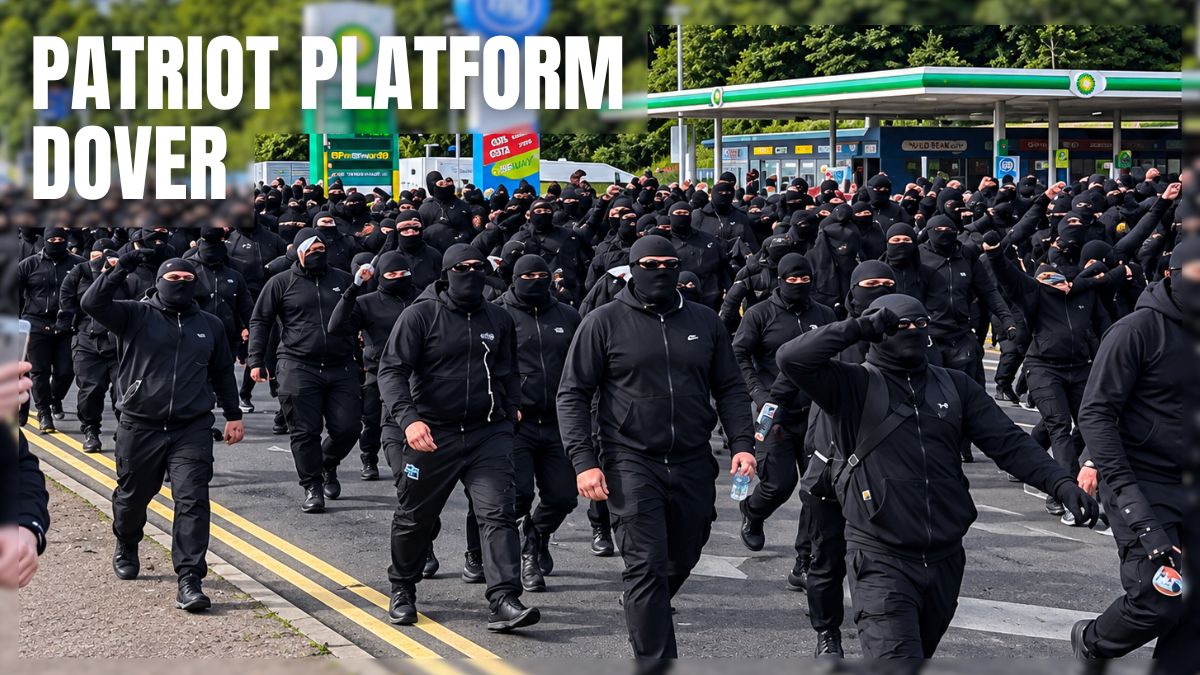
5 September, Dover. Several hundred men dressed in black, most wearing balaclavas, blocked roads around the port early on a Saturday morning, halting traffic in and out. Kent Police said it had responded to a “spontaneous protest” and made no arrests, Sky News reported. Dover’s Labour MP, Mike Tapp, wrote that the protest had clearly been organised and asked why police had so little warning (CBS News). Thomas posted on X that patriots had “mobilised to close down the port”, Sky reported. Hope not Hate reported that masked men also sprayed “Blood is on your hands” outside a site used to process asylum seekers.
6 September, Portsmouth. After RNLI lifeboats brought more than 100 people from a single dinghy ashore at Eastney, around 200 protesters, many masked, blocked the road out to stop them being taken to a processing centre. Police said a number of police, Coastguard and Border Force vehicles were damaged and a small number of officers were treated at the scene, none seriously hurt, Sky News reported. Sky named Thomas as one of the organisers. Footage posted online showed lifeboat volunteers being called traitors. The RNLI’s chief executive called the abuse “wholly unacceptable in a civilised society”, LBC reported, and four days later the Portsmouth station was out of service, the University of Portsmouth noted.
10 to 18 September. The Home Secretary, Shabana Mahmood, told police forces to make full use of powers to ban face coverings at protests. Thomas led a protest outside the Daily Mail’s London office over its reporting about his family. When he threatened to send thousands of members to Piddington in Oxfordshire if a former military site there was used to house asylum seekers, Mahmood called him far right and an “outright racist” who would face the full force of the law, the Guardian reported.
22 September, Gosport. Thomas urged followers to meet a Border Force landing at Gosport. Several hundred came; the boat went to Dover instead. Police made six arrests on suspicion of offences including assaulting an emergency worker. The same day, Thomas livestreamed himself from a boat in the Channel following a small boat, Reuters reported. He was arrested the following night.
25 September, Basingstoke. The day before, the Crown Prosecution Service had announced that Thomas was charged with criminal damage and with failing to comply with a notice to disclose his phone PIN, following an alleged incident on 22 September in which a boat was damaged at sea (CPS). Hampshire police said the charges followed an allegation that a boat had been damaged in the Channel while an emergency responder was on board (PA via the Irish Examiner). Appearing by video link at Basingstoke Magistrates’ Court, he pleaded not guilty to both charges and was remanded in custody. Several hundred supporters had gathered outside a police investigation centre in Basingstoke the night before. Robinson has publicly backed him and launched an appeal to fund his defence, IBTimes reported. Splits in this world are rarely as clean as the public statements suggest.
On 29 September a judge at Portsmouth Crown Court refused him bail and set a provisional trial date of 1 March 2027, AFP reported. Thomas denies the charges and is entitled to the presumption of innocence.
4 October, Gosport again. RNLI lifeboats brought 149 people rescued from a dinghy in mid Channel into Haslar Marina, the Home Office said. A crowd that police put at around 350 gathered at the police cordon. Flares were set off and there were scuffles with officers, though the BBC described the atmosphere as mostly peaceful. Police arrested 12 people, 11 men and one woman, on suspicion of offences including assaulting police officers, affray and racially aggravated public order offences, ITV News reported. A small number of officers were treated at the scene and nobody was seriously injured. All 12 were still in custody when the BBC reported on 5 October. The reports we reviewed did not identify any group as the organiser. Thomas was in custody throughout.
How Britain’s far right changed between 2024 and 2026
It is tempting to tell this as a neat story: the street gave way to the internet, formal groups gave way to networks, and the old skinhead imagery gave way to flags and hymns. Some of that holds up. Some of it does not.
From the street to social networks? Only partly. What was widely described as the largest far right march in modern British history took place in September 2025, more than a year after the riots. The street did not empty. What changed is that online activity now plans and broadcasts it in real time. Dover was organised as a flash mob and filmed for followers. Gosport began as a call on social media the same day. The livestream is no longer a record of the action. It is a large part of the point.
From formal groups to decentralised campaigns? Yes, then back again. Operation Raise the Colours was genuinely decentralised, with dozens of local crews claiming credit. But the most visible groups have since drifted towards personality. Former members describe Raise the Colours as built around Bridge, and Patriot Platform is openly an attempt to put many small groups under one leader. Decentralisation brought numbers. It also brought splits, rival claims and very public feuds.
From far right branding to patriot language? Clearly yes. Hardly anyone in this timeline calls themselves far right. The vocabulary is patriotism, Christianity, protecting women and children, defending the border. That framing may have helped widen the audience, and it may help explain why flags on lampposts split public opinion rather than turning it decisively against the activists. Underneath, the older far right is still present: Britain First donating flags, its leader billed to address a flagging protest in Shrewsbury in August 2026, a man photographed with an “Aryan Power” banner appearing in Raise the Colours videos.
From online narratives to offline action? Yes, and further than in 2024. The most important new development is direct action at the border itself. In 2024 the targets were hotels and mosques. By late 2025 activists were on French beaches. By September 2026 they were trying to physically block new arrivals at English ports and confronting lifeboat crews.
The continuities matter just as much. Several of the major flashpoints examined here followed a crime, real or rumoured, that could be tied to immigration or race: Southport, Epping, Henry Nowak’s murder in Southampton, a stabbing in north Belfast that preceded racist attacks on homes across Northern Ireland in June 2026. Robinson remains the hub that newer groups orbit, even when they insult him. And the claim of “two tier policing”, dismissed by MPs in 2025, keeps coming back because it works as a story whatever the evidence says.
The state’s response has changed too. The tools of 2024 were mass arrests and fast sentencing. The tools of 2026 are civil injunctions against flagging, entry bans in France and new limits on face coverings at protests. This may reflect a change in how the authorities see the problem: less a riot to be contained, more a set of persistent groups to be managed. That reading is ours, though police have acknowledged that groups such as Patriot Platform use tactics “slightly different to what we’ve seen before”, ITV reported.
Is Britain experiencing a resurgence of the far right?
The honest answer depends heavily on what you count, and much of the disagreement is about definitions rather than facts.
The case for a resurgence is substantial. In the year to March 2025, Prevent received 1,798 referrals over extreme right wing concerns, 21% of the total and up from 1,314 the year before, according to Home Office statistics. That was more than twice the number referred over Islamist extremism. Add the scale of the 2024 riots, a march of 110,000 or more in 2025, the violence in Southampton and Belfast in June 2026, and the growth of groups prepared to confront people at the border, and the picture is of something larger and more confident than three years ago. Hope not Hate’s State of Hate 2026 report warned that the far right was “more extreme, bigger and bolder than ever before”. In August 2026 the Society of Radiographers reported a noticeable rise in racist abuse against its members over the previous 18 months, which it linked to increasingly hostile rhetoric about immigration.
The counterarguments deserve a fair hearing. Prevent figures measure referrals, not the number of people holding extremist views, and they rise and fall with how willing schools and agencies are to refer; more than half of all referrals that year involved no clear ideology at all. Critics, including UnHerd, argue that Hope not Hate uses a definition of the far right broad enough to sweep in mainstream voters, and point out that its 2026 report opened with an appeal to donate to stop Reform UK. Millions of people voted Reform in 2025 and 2026, and most would reject any suggestion that they are extremists.
The activist numbers are also smaller than the noise. Raise the Colours claimed 25,000 sign ups for a conference whose website, The i Paper found, had been visited about 14,400 times before the event was cancelled. Patriot Platform’s 45,000 registrations are self reported. Robinson’s May 2026 march was smaller than his September 2025 one.
What the evidence supports is narrower but still serious. Hostility to immigration has moved closer to the political mainstream. A small but determined set of street activists has become more willing to confront people directly, including at the border, and has learned to use national symbols and Christian language to reach beyond its usual audience. What the evidence cannot yet show is how many people are actively involved, or whether 2026 marks a peak or a plateau.
What happens next?
The main change between 2024 and 2026 is not size so much as method. Britain’s far right has moved from a riot sparked by a lie to a set of small, persistent, camera ready groups that pick fixed targets (lampposts, hotels, ports, lifeboat stations) and keep coming back.
Some things are already scheduled. Ryan Bridge is due before Oxfordshire magistrates on 3 November. Daniel Thomas, who denies the charges against him, faces a pretrial hearing on 12 November and a provisional trial date of 1 March 2027. Birmingham’s injunction application is pending, and the new limits on face coverings will be tested at the next masked protest. Beyond that, we will not guess.
This is a living timeline. We will update it as significant developments occur and correct it promptly if anything here turns out to be wrong.
Related reading
- Patriot Platform Explained: Who Are They and What Do They Want?
- Anti-Reform UK Merchandise: The Story Behind Rotten Reformers
Last updated: 6 October 2026